
The excitement is building as UEFA has officially confirmed the pot allocations for the 2024-25 Champions League group stage draw, and this year brings something entirely different. With the introduction of a revolutionary format that replaces the traditional group system with a single league phase, football fans around the world are eager to see how their favorite clubs will fare. Jw7 brings you the complete breakdown of the pots, the new format, and what it all means for the upcoming season.
The New Format: What Has Changed?
For the first time in Champions League history, the 2024-25 season will feature a 36-team league phase instead of the traditional eight groups of four. This marks one of the most significant structural changes in European club football since the competition’s rebranding in 1992.
How the League Phase Works
Each team will now play eight matches against eight different opponents—four at home and four away. The opponents are determined through a seeding system based on the pot allocation, with each club facing two teams from each of the four pots. This ensures a balanced fixture list while maintaining the competitive integrity that makes the Champions League so special.
The top eight teams in the league phase will advance directly to the round of 16, while teams finishing 9th through 24th will enter a playoff round to determine the remaining eight spots. The bottom eight teams will be eliminated with no Europa League safety net, raising the stakes significantly.

Champions League 2024-25 Pot Allocations
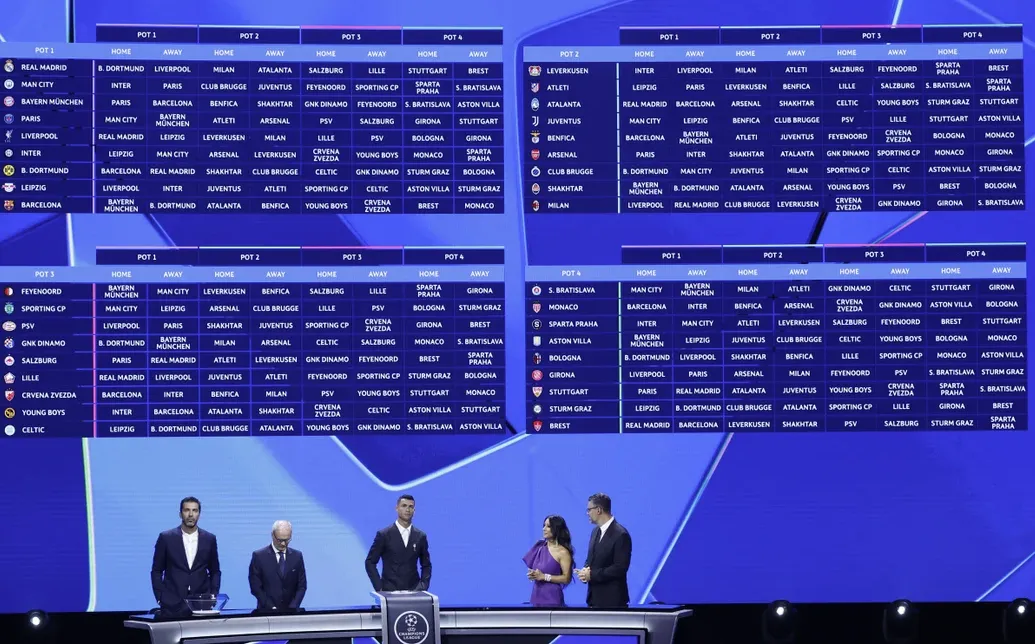
The pots for the draw have been determined by UEFA’s club coefficient rankings, with the Champions League title holders and Europa League winners receiving automatic top-seed status. Here is the complete breakdown of how the 36 qualified teams are distributed.
Pot 1: The Elite Contenders
Real Madrid (Champions League holders and Spanish champions)
Manchester City (English Premier League winners)
Bayern Munich (German Bundesliga champions)
Paris Saint-Germain (French Ligue 1 winners)
Liverpool (English Premier League runners-up)
Inter Milan (Italian Serie A champions)
Borussia Dortmund (German Bundesliga runners-up)
RB Leipzig (German Bundesliga fourth place)
Barcelona (Spanish La Liga runners-up)
Pot 2: The Heavy Challengers
Bayer Leverkusen (German Bundesliga champions and Europa League winners)
Atletico Madrid (Spanish La Liga fourth place)
Atalanta (Italian Serie A fourth place)
Juventus (Italian Serie A third place)
Arsenal (English Premier League runners-up)
Club Brugge (Belgian Pro League champions)
AC Milan (Italian Serie A runners-up)
Benfica (Portuguese Primeira Liga champions)
Shakhtar Donetsk (Ukrainian Premier League champions)
Pot 3: The Dangerous Outsiders
Feyenoord (Dutch Eredivisie champions)
Sporting CP (Portuguese Primeira Liga runners-up)
PSV Eindhoven (Dutch Eredivisie runners-up)
Celtic (Scottish Premiership champions)
Red Bull Salzburg (Austrian Bundesliga champions)
Dinamo Zagreb (Croatian First League champions)
Olympiacos (Greek Super League champions)
Lille (French Ligue 1 fourth place)
Sturm Graz (Austrian Bundesliga runners-up)
Pot 4: The Underdogs with Potential
Aston Villa (English Premier League fourth place)
Bologna (Italian Serie A fifth place)
Girona (Spanish La Liga third place)
Stuttgart (German Bundesliga third place)
Brest (French Ligue 1 third place)
Monaco (French Ligue 1 runners-up)
Slovan Bratislava (Slovak Super Liga champions)
Sparta Prague (Czech First League champions)
Young Boys (Swiss Super League champions)
Analysis of Key Pot Storylines
The Juggernauts in Pot 1
Real Madrid, with their record 15 titles, headline Pot 1 as both the Champions League and Spanish champions. Their experience in knockout football is unmatched, but the new format demands consistency across eight matches rather than just surviving a group. Manchester City, the defending English champions, remain formidable, especially with their deep squad and Pep Guardiola’s tactical genius. Bayern Munich and Liverpool bring their own credentials, while Paris Saint-Germain continues their quest for a first title with a retooled squad following Kylian Mbappé’s departure.
Inter Milan, fresh off their Serie A triumph, have proven they can compete at this level after reaching the 2023 final. Borussia Dortmund, finalists last season, owe their Pot 1 status partly to their strong European coefficient despite a mixed domestic campaign. RB Leipzig and Barcelona round out the group, each with something to prove after inconsistent seasons.
According to football analyst James Thornton of the European Football Research Institute, “The new format actually benefits Pot 1 teams because they control their seeding entirely. The top eight clubs in the coefficients earned their places, and they’ll be the hardest to dethrone in the league phase.”
The Landmines in Pot 2
Pot 2 is arguably where the most dangerous teams reside, making it critical for Pot 1 clubs to avoid these sides in the draw. Bayer Leverkusen, coming off an unbeaten domestic double and Europa League triumph under Xabi Alonso, are arguably the most feared team in this pot. Their intense pressing style and deep squad make them potential dark horses for the entire competition.
Arsenal returns to the Champions League with something to prove after their impressive Premier League campaign. The Gunners’ youthful squad has matured significantly and could threaten even the strongest opposition. AC Milan and Juventus bring Italian tactical discipline, while Atletico Madrid remains a nightmare for any opponent with Diego Simeone’s defensive organization.
Benfica and Club Brugge have consistently shown they can compete with Europe’s elite, while Shakhtar Donetsk’s resilience continues to impress despite playing away from home due to the conflict in Ukraine.
Pot 3: The Potential Giant Killers
This pot contains clubs that could disrupt the established order. Celtic, under new management, have dominated Scottish football and will be confident at Parkhead. Sporting CP and PSV Eindhoven both possess young talents that European giants covet, making them dangerous opposition.
Olympiacos, Dinamo Zagreb, and Red Bull Salzburg have extensive Champions League experience and know how to navigate the competition’s demands. Lille, Brest’s qualification represents a fairytale journey, with the club reaching Europe’s top table for the first time since 2011.
Pot 4: The Intriguing Stories
Aston Villa returns to the Champions League for the first time since 1982, when they won the competition. Their transformation under Unai Emery has been remarkable, and while they lack recent European experience, they should not be underestimated. Bologna and Girona both surprised their domestic leagues to earn places, while Stuttgart’s renaissance continues as they add European football to their achievements.
Monaco, with their history of developing talent, could surprise teams viewing them as an easy draw. Slovan Bratislava and Sparta Prague will embrace their underdog status, hoping to cause upsets.
What This Means for the Draw
The draw, scheduled for August 29 in Monaco, will use a combination of manual and automated processes to allocate opponents. Each team will receive two opponents from each pot, with one home and one away match per pot. This system replaces the old manual procedure that created groups with distinct identities.
Former Real Madrid midfielder and now pundit Luis Fernandez shared his thoughts with Jw7: “The new format makes every match count. You can’t coast through easy groups anymore. The top teams will face multiple top teams every season, which adds incredible drama.”
Key Matchups to Watch
While specific fixtures won’t be determined until the draw, some potential matchups stand out based on the pot structure. Manchester City could draw Arsenal in a reprise of their Premier League battles, while Liverpool meeting AC Milan would revive memories of iconic finals. Real Madrid facing Juventus always carries extra meaning given their Champions League history.
Barcelona versus Bayern Munich would continue one of modern football’s most fascinating rivalries, while Paris Saint-Germain against Arsenal could feature dramatic individual battles.
The Road to Munich
The 2024-25 Champions League final will be held at the Allianz Arena in Munich, Germany, on May 31, 2025. For Bayern Munich, playing a home final adds extra motivation, but the revamped format means any of the 36 teams could theoretically reach the final with consistent performances.
The league phase will run from September 17 to January 29, 2025, with playoff rounds in February. The knockout stage follows the traditional home-and-away format through March, April, and May.
Conclusion
The Jw7 analysis shows that the 2024-25 Champions League promises to be the most unpredictable and thrilling edition yet. The pot allocations reveal a competition packed with elite clubs, dangerous dark horses, and inspiring underdogs all vying for European football’s greatest prize.
From Real Madrid’s bid for a 16th title to Aston Villa’s return after 42 years, from Bayer Leverkusen’s quest to prove their invincibility to Celtic’s hopes of rediscovering their European magic, every match will carry meaning.
As the draw approaches, fans can only imagine the potential matchups and storylines that await. The beautiful game continues to evolve, and this new chapter in Champions League history will surely deliver unforgettable moments.
What do you think about the pot allocations? Which teams do you believe will thrive in the new format? Share your thoughts in the comments below and stay tuned to Jw7 for complete coverage of the 2024-25 Champions League draw and every match that follows.
